


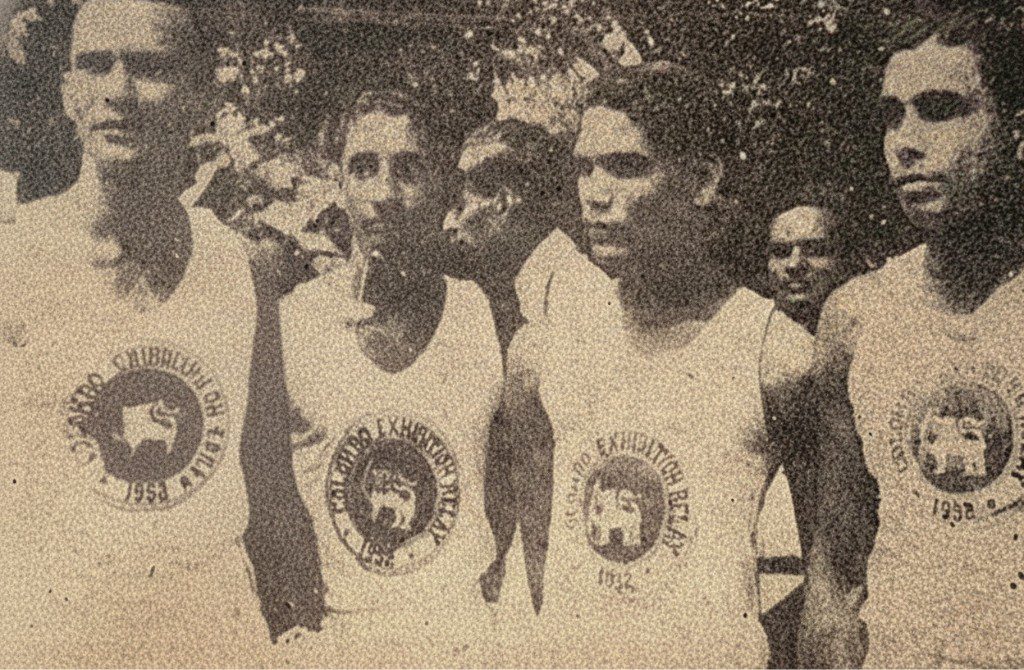
On 4 February 1948, as Ceylon marked its independence as a Dominion, a quiet yet powerful act of unity unfolded at Independence Square. Four young athletes, each representing one of the country’s main communities and different corners of the island, carried ceremonial scrolls to be handed over to the nation’s first Prime Minister, D. S. Senanayake.
The athletes were Duncan White representing the Burgher community, Lakshman Kadirgamar representing the Tamil community, Mustafa Sherrif representing the Muslim community, and Oscar Wijesinghe representing the Sinhalese community. Their presence symbolised a young nation stepping forward together.
What is less widely known, and not captured in the familiar photograph, is what followed upon their arrival at Independence Square. The four athletes handed over the scrolls to four young women, each representing the same communities. They were Swarna Amarasuriya, Srimani Ramachandran, Ayesha Zally, and Phyllis de Kretser. In turn, these young women presented the scrolls to the Prime Minister, who read them aloud to the gathered crowd.
Among the four athletes, Lakshman Kadirgamar was only sixteen years old at the time. He would later take a different path, one that led him into public service and national leadership. The other three were already accomplished sportsmen, each having represented Ceylon at the British Empire Games. Later that same year, Duncan White would bring further honour to the country by winning an Olympic silver medal, placing Ceylon firmly on the global sporting stage.
It is also worth noting a rare and meaningful connection visible in this image. Both Duncan White and Lakshman Kadirgamar were old boys of Trinity College, Kandy, making it significant to see two Trinitians standing together at such a defining national moment. One would go on to earn international recognition in sport, while the other would later serve Sri Lanka with distinction in public life. Their presence side by side reflects the breadth of paths taken by Trinity men, shaped by shared values and a sense of service.
Writing in The Island in 2021, the late Mr K. L. F. Wijedasa reflected on this moment in his article A Historic Day for Ceylon, recalling how the athletes and young women together embodied the spirit of the nation at birth. His words serve as a gentle reminder that unity was not merely spoken of on that day, it was carefully enacted.
It is also worth noting a small but important detail. Although the photograph is often associated directly with the events of 1948, it was in fact taken in 1952, a fact that can be faintly seen on the athletes’ jerseys. Even so, the image continues to represent a defining ideal of the country’s independence.
Nearly eight decades on, this moment from Sri Lanka’s history reminds us that unity across communities has always been central to who we are. It is a lesson that remains just as relevant today!
(Information compiled with reference to The Sidelines, archival material from Trinity College, Kandy Archives, historical commentary by K. L. F. Wijedasa, and the writer’s own reflections.)
-SA