GENERAL ARTICLES

On 31st July 1948, Ceylon, as Sri Lanka was then known, stood proud on the global sporting stage for the very first time. At the London Olympics, Duncan White thundered down the track in the 400 m hurdles final, crossing the line in a remarkable 51.8 seconds, just seven-tenths of a second behind gold medallist Roy Cochran of the United States.  It was a silver medal that became a source of immense national pride. Won in the very year Ceylon gained independence from British rule, White’s achievement stood alone as the country’s only Olympic medal for more than half a century, until Susanthika Jayasinghe claimed silver at the Sydney Olympic Games in 2000.  As we mark the anniversary of that historic run, we look back at the life, character, and enduring legacy of a man whom Trinity College proudly calls one of its own.  Formative Years: Forged at Trinity College  Duncan White was born on 1st March 1918 in Kalutara, the second of four children to John Bernard White and Cecilia Hawk White. When the family relocated to Kandy in pursuit of a better education for their children, Duncan and two of his brothers were enrolled at Trinity College.  The family home stood barely 200 metres from the school, along the edge of the Udawatte Kele forest, and it was here, perhaps, that the seeds of a champion were first sown. Each morning, upon hearing Trinity’s opening bell at 7.55 a.m., young Duncan would sling his bag over his shoulder and sprint the distance to school, invariably arriving ahead of the pack.  He first tried his hand at rugby and boxing, but it did not take long for his coaches, Major Harry Hardy and Philip Buljens, to recognise the raw talent in his frame and redirect him towards the track, where he would go on to excel in the hurdles and the long jump.  His ascent through the ranks of Trinity athletics was rapid and unrelenting:  1934: Selected for the Trinity athletics team at the age of just sixteen.  1936: Appointed Track Captain at eighteen. He set new school and national records in the 220-yard sprint (23.3 seconds), claimed victory in both the 110-yard hurdles and the long jump, and led Trinity to its first Tarbet Trophy overall championship.  1937: Awarded the coveted Trinity ‘Lion’ for athletics before even earning his standard school colours, a rare distinction, though one that was later briefly withdrawn on disciplinary grounds. That same year, he broke the national 440-yard hurdles record twice, lowering it to 50.4 seconds before his time at Trinity came to an end.  The Historic Run in London  After leaving school, White served with the Ceylon Light Infantry during the Second World War before setting his sights on the 1948 London Olympic Games.  His path to the podium was anything but easy. While his closest rivals had spent up to four years in dedicated training, White had barely three months to prepare, hampered by limited infrastructure and scarce resources back home. Drawn into the outer fifth lane for the final, he was, by every measure, the underdog.  Yet he ran as though none of that mattered, surging into the lead and holding it through the seventh hurdle before ultimately settling for silver. For a nation newly stepping into independence, it was a golden chapter in every sense but name.  The Return of the Lion  Olympic glory brought White worldwide recognition, but by his own account, nothing compared to the reception that awaited him back home in Kandy. A grand procession wound through the town in his honour, culminating in an assembly at the Trinity College Hall, where the entire school gathered to celebrate one of its own.  There, Principal C. E. Simithraaratchy formally restored and re-awarded White the Trinity ‘Lion’ that had once been taken from him. Those present recalled tears in his eyes as he received it, a moment that gave rise to one of the most enduring quotations in Trinity’s history:  “My victory at the Olympics is prestigious, but the Lion makes me feel more honoured than that.”  Duncan White  White went on to marry Angela Siebel in 1952, and together they raised six children. He passed away on 3rd July 1998, at the age of eighty, in Nuneaton, Warwickshire. In August 1999, his family entrusted his 1948 Olympic silver medal to the Trinity College Archives, where it remains on display to this day, a permanent reminder of a Trinitian who carried his nation’s hopes onto the world stage.  A Message to Future Generations  Duncan White’s story is, at its heart, a lesson in character over circumstance. Reflecting on the hardships he overcame, the late Hon. Lakshman Kadirgamar once remarked:  “White’s sporting career was not a bed of roses; at one point he was struggling even to buy a proper pair of spikes, but his strong desire to win brought him up to where he was.”  Hon. Lakshman Kadirgamar  Speaking at a memorial held in his honour in 1999, former Minister Anurudha Ratwatte offered his own tribute to the Trinity legend:  “Duncan White was an exceptional athlete from Trinity; his sheer dedication made him win the only Olympic medal for Sri Lanka. He was a great patriot and a perfect role model for young sportsmen.”  Minister Anurudha Ratwatte  For every Trinitian, and indeed every athlete who reads his story, Duncan White’s life offers a simple but enduring truth: no hurdle is too high, and no shortage of resources is insurmountable for a heart set on excellence.  Reviewed by Humrushan Thivaharan (College Archives Team) View this post on Instagram A post shared by Trinity College Kandy (@trinitycollege.lk)
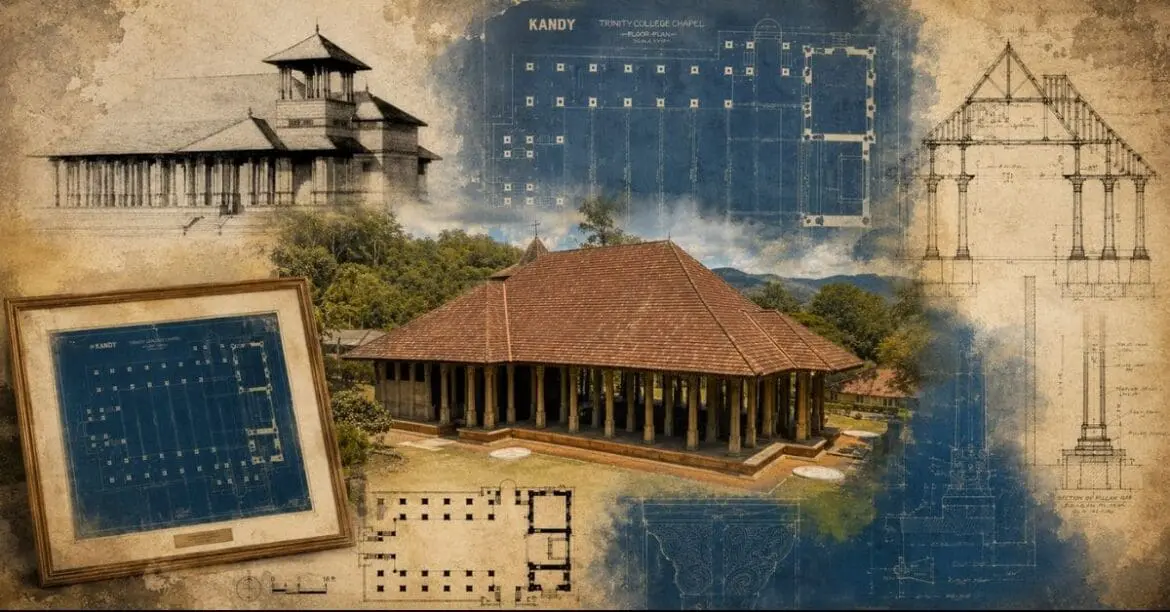
Few creations endure as powerfully as those built with a vision that extends beyond a single lifetime. At Trinity, many buildings have stood for more than a century, quietly bearing witness to generations of students who have passed through their halls. Among them, the College Chapel occupies a special place, not merely as a landmark of architectural beauty, but as a symbol of the ideals upon which the College was founded.  For over one hundred years, the Chapel has remained at the heart of Trinity. Its soaring pillars, intricate carvings, and distinctive character have become familiar to generations of Trinitians. Yet behind the stone, timber, and craftsmanship lies a story of vision, dedication, and painstaking work, a story preserved today through a remarkable collection of original architectural drawings.  At the centre of that story stands Rev. Lewis John Gaster.  Rev. Gaster arrived at Trinity in January 1911 during the principalship of Rev. A. G. Fraser. During his years at the College, he became widely known as the “Master of Method”, a title that reflected the esteem in which he was held as an educator. He later served as Head Master and eventually as Vice-Principal. Beyond his contributions to education, he played an important role in fostering unity among the various branches of the Church in Ceylon, helping to establish a spirit of cooperation that continued to grow under his influence.  Yet it is perhaps through the College Chapel that Rev. Gaster’s vision found its most enduring expression.  The Chapel was never conceived merely as a building. Every detail reflected careful thought and purpose. The carvings in wood and stone, many of which continue to draw admiration today, were executed under Rev. Gaster’s close personal supervision. His commitment extended beyond broad architectural concepts to the finest details of craftsmanship, ensuring that the finished structure would embody both beauty and meaning.  The earliest surviving evidence of this vision can be found in a drafted plan dated 10 October 1922, prepared in Colombo under Rev. Gaster’s supervision. The drawing is believed to have been executed by Henry Schaetti, the distinguished Swiss architect whose work would later leave a lasting influence on Sri Lankan architecture.  However, the transformation of vision into reality required another gifted individual whose contribution deserves equal recognition.  That individual was Mr Clement Leo Unamboowe.  Mr Unamboowe entered Trinity College on 3 March 1911 from C. M. S. Gampola at the age of ten. Following his schooling, he joined Walker Sons and Co. Ltd., where his talent as a draughtsman began to flourish. Rev. Gaster himself described him as a young man who was “developing into an excellent draughtsman”, noting not only his technical ability but also the originality and artistic merit evident in his work.  At a remarkably young age, Mr Unamboowe undertook the demanding task of preparing the detailed architectural blueprints of the Chapel. He was also responsible for drafting the plans of the Gaster Block, which today houses Grade 11 classrooms.  In an era long before digital design tools, architectural drawings demanded exceptional patience, accuracy, and skill. Every measurement, line, and detail had to be drafted by hand. Through countless hours of meticulous work, Mr Unamboowe translated Rev. Gaster’s ideas into technical drawings that builders could follow, creating the bridge between imagination and construction.  Nearly a century after those drawings were prepared, an extraordinary chapter was added to their story.  On 19 August 2022, as Trinity College marked the centenary of the laying of the Chapel’s foundation stone, the College Archives received a gift of immense historical significance. The original drawings prepared by Mr C. L. Unamboowe and signed by Rev. L. J. Gaster in October 1924 were generously donated to the Archives, ensuring their preservation for future generations.  The collection included:  These invaluable documents were donated by Mr Unamboowe’s grandsons, Mr Prince Unamboowe and Mr Neil Unamboowe, whose generosity has returned an important piece of Trinity’s architectural heritage to the College.  Today, visitors entering the Chapel see a completed masterpiece. They see the stone pillars, the timber work, the carvings, and the familiar silhouette that has become inseparable from Trinity’s identity. What they do not immediately see are the years of thought, planning, and labour that preceded its construction.  The original blueprints allow us to glimpse that earlier story.  They remind us that great buildings do not emerge by chance. They begin as ideas, shaped by vision, refined through skill, and realised through dedication. Rev. Gaster provided the inspiration and direction. Mr Unamboowe transformed that vision into drawings of remarkable precision. Together, they helped create a building that has served the College for more than a century.  As these drawings now rest within the College Archives, they offer more than a record of architectural history. They preserve the story of the individuals whose work continues to shape the experience of every Trinitian who enters the Chapel. More than a century after the first lines were drawn on paper, their legacy remains etched in stone, timber, and memory.  __  Article by Navindu Karunarathne (Student Archivist)  Edited by S.A.  Sources: The Centenary Number; A Sinhalese Chapel for Trinity College, Kandy; Trinity College, Kandy Archives; History of the Unamboowe Family; internet research. 
An article by Hamzah Mohomed Hanas (Web Content Team) Humans and nature have long shared a close and meaningful connection. Yet, as technology becomes a larger part of our daily lives, we often find ourselves drifting away from the natural systems that sustain us. Trees, for instance, may appear ordinary at first glance, but they play an essential role in supporting life on Earth. Together with the lithosphere (land), hydrosphere (water), and atmosphere, they form the delicate balance of the Earth’s biosphere. With an estimated 8.6 million species of plants and animals on our planet, each contributing in its own way, caring for this diversity remains a shared responsibility. At Trinity College, we thought to mark World Earth Day by reflecting on the importance of protecting our environment in a rapidly changing world. For over 150 years, College has grown alongside nature, and this relationship continues to shape the experiences we have as students. The College campus itself is home to a rich collection of mature trees, some of which have stood for decades, quietly shaping the character of the school. In recent years, efforts have been made to help students better recognise and appreciate these trees, with selected species around the campus now carefully labelled. One such space is the Trinity Eco Learning Arena (TELA) in Pallekele. Set amidst natural surroundings, TELA provides a safe habitat for a variety of plant and animal species. The green spaces here support carbon capture and help regulate the local environment. More importantly, it serves as a place where students can learn directly from nature. Through guided activities, they begin to understand the value of conservation and the role they can play in protecting it. Across the College, several student-led groups contribute to this shared effort. The Junior School Nature Club, Wildlife Society, Ornithology Club, Environmental Pioneer Brigade, Interact Club, and the Young Inventors and Research Club organise programmes such as Climate Week, ‘Wings Through the Lens’ wildlife photography competition, Go Green reforestation projects, and city clean-ups. These initiatives encourage students to take small but meaningful steps towards caring for their surroundings. Among these efforts, the Horticulture Society has played a key role in drawing attention to the natural surroundings of the College by identifying and labelling significant trees found across the premises, helping students, staff, and visitors engage more closely with their environment. At the Trinity College Farm in Pallekele, students are given the opportunity to engage with nature in a more hands-on way. The farm supports pollinators and beneficial insects, while natural fertilisers such as animal manure help maintain soil health. These practices reduce the need for chemical inputs and protect nearby water sources. Through these experiences, students begin to appreciate how even small ecosystems can be nurtured and sustained. Recognising the challenges posed by climate change, College has also taken steps towards more sustainable practices. The installation of a solar power system reflects a shift towards renewable energy, while students are encouraged to reduce the use of polythene and plastic, and to be mindful of single-use consumption. Beyond the main campus, Trinity’s connection with nature extends to its iconic sporting venues. The Pallekele Rugby Stadium, set amidst wide open spaces and surrounding greenery, offers a scenic environment where the natural landscape becomes part of the experience of the game. Similarly, the Asgiriya Cricket Stadium, with its calm setting and tree-lined surroundings, reflects the close relationship between sport and nature at Trinity, adding to the sense of tradition and character associated with the ground. In marking World Earth Day, we are reminded of the role we each play in caring for the environment around us. From the trees that line our pathways to the wider spaces that shape our daily experiences, nature remains a quiet but constant presence in our lives. Learning to recognise and value this connection is an important step towards protecting it for the future. As Trinitians, we should strive to become thoughtful and responsible stewards of the environment, mindful of the impact of our actions. Take a moment. Look around. Protect what quietly sustains us!
Article by Ravindu Herath (Student Archivist – Trinity College Archives & Museum Team)  On 19 March 1915, Trinity College, Kandy, marked a significant moment in its sporting history with the inaugural awarding of the College Lion, the highest honour in sports at Trinity. Among the first recipients were sportsmen such as R. Ondatje, Richard Aluwihare, W. P. Beligammana, H. C. Inman, and M. P. Kallora, who had demonstrated both skill and commitment. The Cricket Eleven received the highest number of awards, highlighting the strength of the game at the College at the time.  Awarded on the recommendation of the Sports Committee, the College Lion award recognised boys who, at the time, had achieved distinction in athletics or contributed meaningfully to the standard of sport at the College. The first presentation took place when the Principal formally announced the recipients, establishing a tradition that continues to hold deep significance.  Lions were awarded across a range of disciplines, including Cricket, Rugby, Boxing, Shooting, Marching, Military Efficiency, and General Efficiency in Sports. In total, eighteen Lions were awarded on that day, reflecting the breadth of sporting activity at Trinity during this period.  This symbolic award is presented in the form of a cloth bearing the College crest, which recipients may stitch onto their blazer. At the base of the crest are the initials of the sport for which the Lion has been awarded, for example, ‘T.C.K.F.C.’ for Trinity College Kandy Rugby Football Colours and ‘T.C.K.C.C.’ for Trinity College Kandy Cricket Colours. It was also observed that similar recognition might be extended to excellence in academic pursuits, such as achieving a First Class in the Cambridge Locals. This reflects an early understanding that achievement at Trinity should not be limited to the playing field alone. The introduction of the College Lion established a tradition that remains one of the most respected honours at Trinity, representing discipline, consistency, and contribution to College life.  Today, we remember these early recipients not only for their achievements, but for setting a standard that continues to guide Trinity students. Whether in sport or in the classroom, the values they upheld remain central to the life of the College.  Source: from the Trinity College Kandy Archives & Museum 
Article by Kanish Krishnapradeep (Student Archivist – Trinity College Archives & Museum Team) On 20 February 1901, Reverend Robert Wright Stopford was born in Garston, Lancashire. Today, we mark the 125th anniversary of his birth and remember his lasting contribution to Trinity College, Kandy. Rev. R. W. Stopford served as Principal of Trinity College, Kandy from 1935 to 1941, a period marked by educational transition and reform in Sri Lanka. A graduate of Hertford College, Oxford, where he obtained first-class honours in Modern History and Classics, he brought intellectual clarity and steady leadership to the College. During his tenure, he played an active role in shaping curricular change at a critical moment in the island’s educational history. Even before legislative reform required it, he supported the introduction of Sinhala and Tamil as languages of instruction in the primary school, recognising the importance of rooted, inclusive learning. His leadership extended beyond the classroom. Rev. Stopford cleared the College’s outstanding debt to the Church Missionary Society (C.M.S.), strengthening its financial footing, and oversaw the construction of a new hall, now used as the College Main Hall. Not content to delegate entirely, he personally designed the stage and arranged the lighting, reflecting a hands-on commitment to excellence in both form and function. He believed that education must shape the whole person. It was not unusual to see him participating in morning physical training at Asgiriya alongside the boys. Academic rigour, in his view, was inseparable from discipline, sportsmanship, and character. He expected high standards of conduct, encouraged wise use of community resources, and taught students to accept both victory and defeat with composure. Before departing Trinity to continue his ministry in Africa, he left the College community with words that captured his philosophy: “Think Fairly, Build Bravely, Love Widely.” Rev. Stopford went on to serve with distinction in the Anglican Church, eventually becoming Bishop of London from 1961 to 1973. He was appointed Knight Commander of the Royal Victorian Order (KCVO) in 1973, in recognition of his service. Today, as we remember his birth anniversary, we give thanks for a Principal whose leadership helped guide Trinity through a defining chapter in its history. His influence remains woven into the life of the College, reminding us that thoughtful reform, steady conviction, and care for the whole student are marks of enduring leadership. Source: from the Archives of Trinity College Kandy
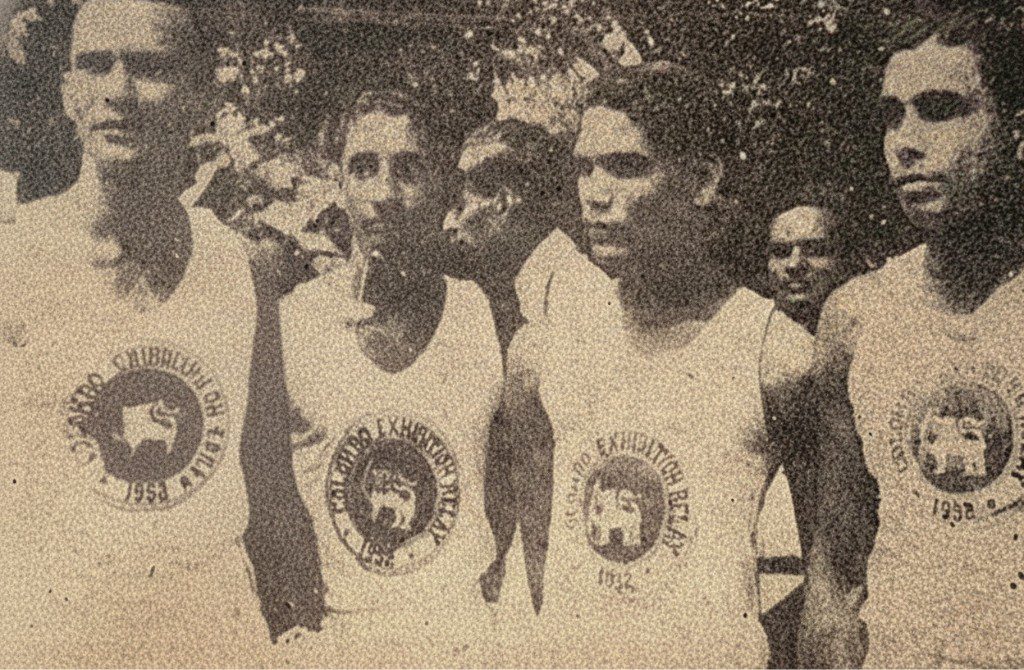
On 4 February 1948, as Ceylon marked its independence as a Dominion, a quiet yet powerful act of unity unfolded at Independence Square. Four young athletes, each representing one of the country’s main communities and different corners of the island, carried ceremonial scrolls to be handed over to the nation’s first Prime Minister, D. S. Senanayake. The athletes were Duncan White representing the Burgher community, Lakshman Kadirgamar representing the Tamil community, Mustafa Sherrif representing the Muslim community, and Oscar Wijesinghe representing the Sinhalese community. Their presence symbolised a young nation stepping forward together. What is less widely known, and not captured in the familiar photograph, is what followed upon their arrival at Independence Square. The four athletes handed over the scrolls to four young women, each representing the same communities. They were Swarna Amarasuriya, Srimani Ramachandran, Ayesha Zally, and Phyllis de Kretser. In turn, these young women presented the scrolls to the Prime Minister, who read them aloud to the gathered crowd. Among the four athletes, Lakshman Kadirgamar was only sixteen years old at the time. He would later take a different path, one that led him into public service and national leadership. The other three were already accomplished sportsmen, each having represented Ceylon at the British Empire Games. Later that same year, Duncan White would bring further honour to the country by winning an Olympic silver medal, placing Ceylon firmly on the global sporting stage. It is also worth noting a rare and meaningful connection visible in this image. Both Duncan White and Lakshman Kadirgamar were old boys of Trinity College, Kandy, making it significant to see two Trinitians standing together at such a defining national moment. One would go on to earn international recognition in sport, while the other would later serve Sri Lanka with distinction in public life. Their presence side by side reflects the breadth of paths taken by Trinity men, shaped by shared values and a sense of service. Writing in The Island in 2021, the late Mr K. L. F. Wijedasa reflected on this moment in his article A Historic Day for Ceylon, recalling how the athletes and young women together embodied the spirit of the nation at birth. His words serve as a gentle reminder that unity was not merely spoken of on that day, it was carefully enacted. It is also worth noting a small but important detail. Although the photograph is often associated directly with the events of 1948, it was in fact taken in 1952, a fact that can be faintly seen on the athletes’ jerseys. Even so, the image continues to represent a defining ideal of the country’s independence. Nearly eight decades on, this moment from Sri Lanka’s history reminds us that unity across communities has always been central to who we are. It is a lesson that remains just as relevant today! (Information compiled with reference to The Sidelines, archival material from Trinity College, Kandy Archives, historical commentary by K. L. F. Wijedasa, and the writer’s own reflections.) -SA
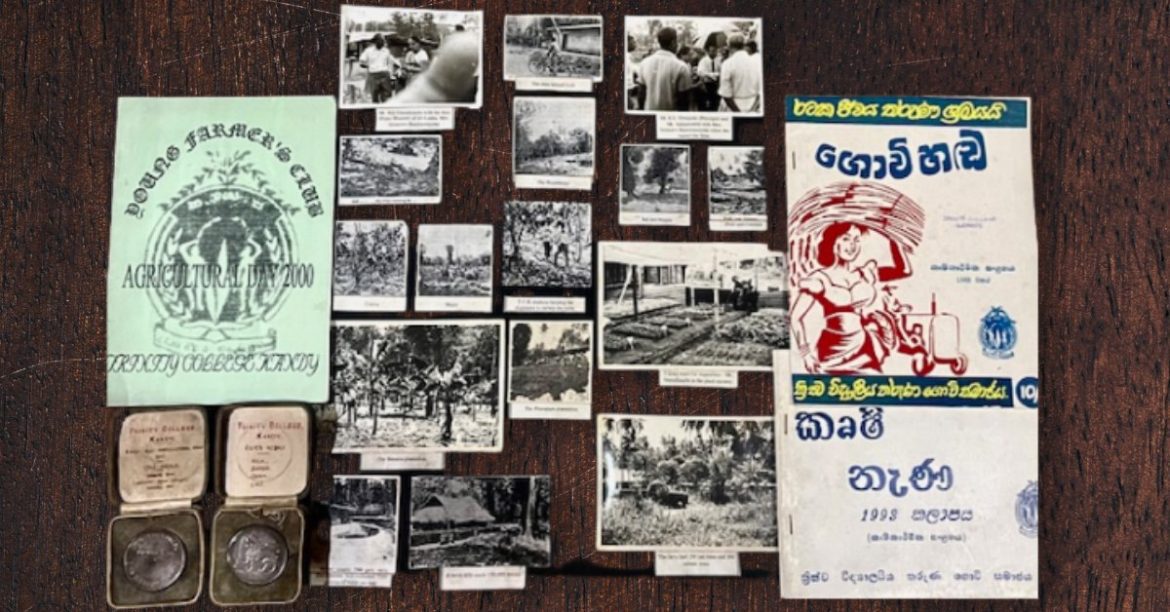
On 30 October 1925, a seed was planted in the rich soil of Trinity College, one that would grow into the Young Farmers’ Club. What began as a small effort to introduce students to the discipline of agriculture has flourished into a century-long tradition of nurturing the land and the values that come with it.  In its early years, six acres of College ground were transformed into a working farm through patience, dedication, and care. The students who toiled there learnt lessons far beyond the classroom: the dignity of labour, the value of the earth, and the satisfaction that comes from growing something with one’s own hands. Their efforts drew the attention of the Governor himself, who praised the initiative during a visit to the College.  Though the Club experienced periods of rest, much like the land between harvests, it never lost its vitality. Each revival—in 1952 and again in 1971—brought renewed energy and purpose. Under the guidance of devoted patrons such as Mr McLeod Campbell, Mr J. N. Thomas, and Mr W. Sinnathamby, the Club expanded its fields of activity, adding piggery, dairy, and large-scale cultivation. These ventures not only strengthened agricultural understanding but also instilled in students a sense of environmental responsibility and respect for nature’s gifts.  The spirit of the Young Farmers’ Club continues to live on in the values it cultivated: a respect for the earth, a willingness to work hard, and a commitment to serve with humility. Its legacy remains deeply rooted in the soil of Trinity College, inspiring generations to care for the land and for one another. Article by: Trinity College Archives & Museum Team
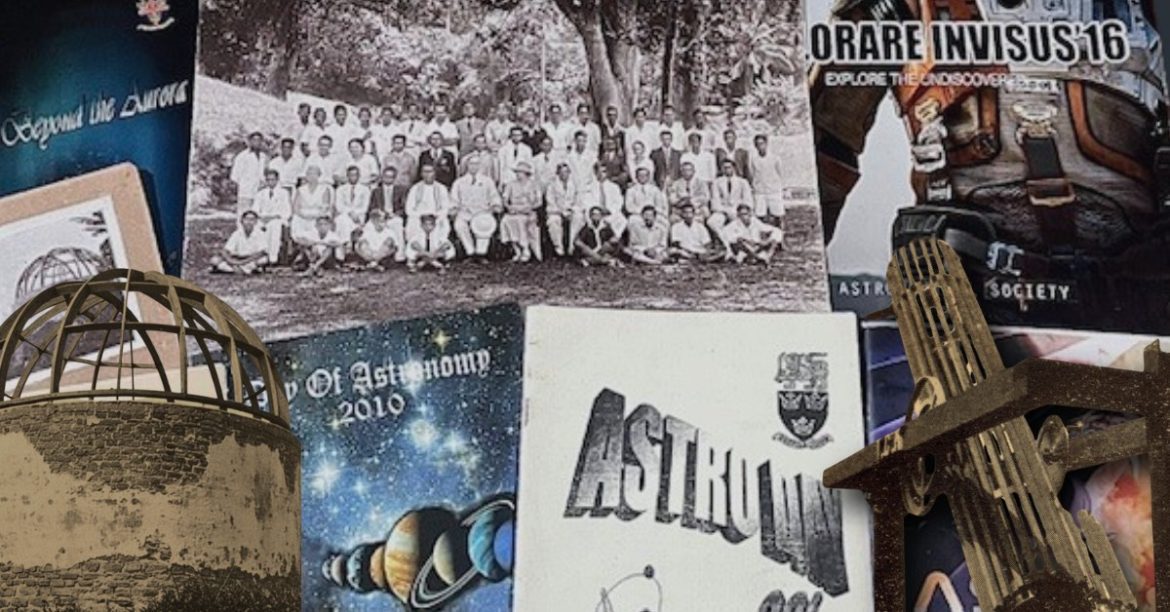
97 years ago, on 22 October 1928, a group of visionary students at Trinity College, Kandy, founded the Astronomical Society. What began as a shared curiosity for the stars soon evolved into one of the College’s most enduring and pioneering student-led societies.  The first Secretary of the Society was P. R. Perera, while the then Principal, Rev. McLeod Campbell, served as its President—underscoring the importance placed on scientific exploration even at that time. The Society’s primary aim was to encourage and facilitate the study of astronomy among students  Among those who contributed significantly to its founding was Mr D. A. Devendra B.A., who was later honoured with a fellowship from the Royal Astronomical Society, a rare distinction that reflects his influence and commitment.  While early meetings were centred on lecture papers, the Society soon aspired to greater heights—quite literally. Within a few years, they began work on an observatory. The construction of the observatory’s mirror was entrusted to Rev. W. F. G. Ellison, Director of the Armagh Observatory in Ireland. The foundation stone was ceremonially laid by Miss Mary Campbell on 19 June 1933.  Just eight months later, the telescope was completed and proudly exhibited in the same year. The observatory’s dome was constructed after the telescope had been installed. This observatory—described at the time as the largest in Ceylon—was officially declared open by Sir Graeme Tyrell, Chief Secretary of Ceylon and Acting Governor.  In 1952, the observatory suffered a major setback when a falling tree severely damaged the telescope. Despite multiple repair efforts, its peak period came to a premature end. Yet, the spirit of discovery continued. Students remained engaged, observing the skies and keeping alive the legacy of those who had once dared to build a window into the cosmos.  Today, as we mark 97 years since its founding, we remember the Astronomical Society with deep gratitude and pride. The passion of those early pioneers still echoes across the generations, inspiring Trinity students to look upwards and think beyond.  Article by: Trinity College Archives & Museum Team 
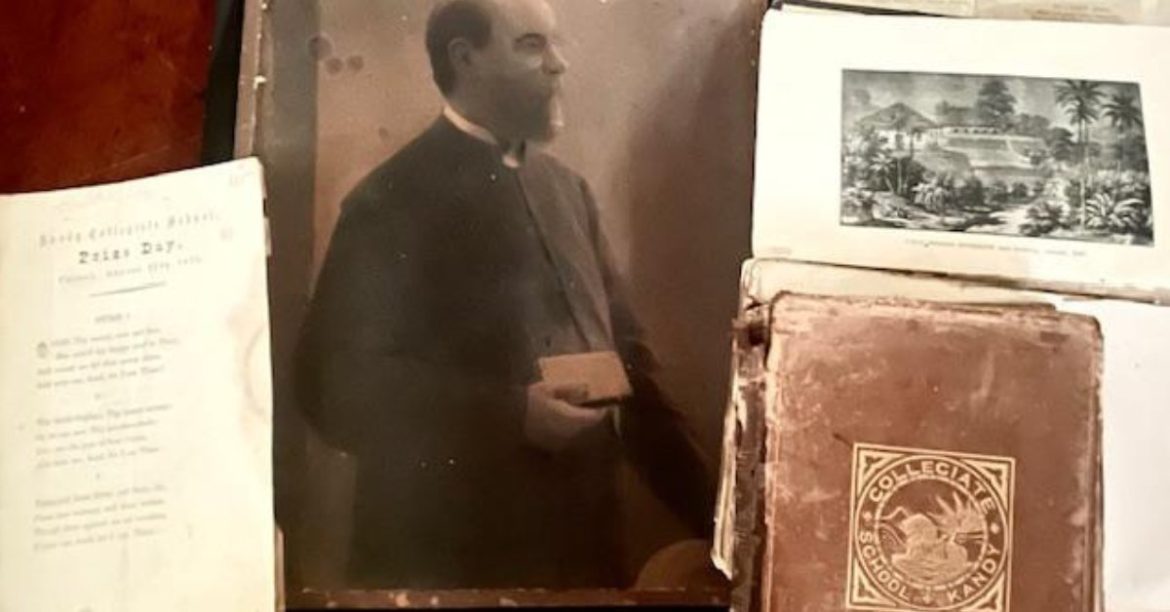
16th October 1858 — On this day 168 years ago, The Kandy Collegiate School, known today as Trinity College, Kandy, was founded by Rev. Ireland Jones with the objective of reaching out to the sons of the Kandyan chiefs and bringing them under the influence of a Christian education. The school was in a flourishing condition during Rev. Ireland Jones’s time, and by 1860 there were sixty students on the roll. In the same year, Rev. Jones—who wished to devote his time entirely to evangelistic work—retired from the Kandy Collegiate School. He was succeeded by Rev. R. B. Tonge, under whose leadership the school began to decline in numbers and was eventually closed in 1863 or 1864. However, the Sinhalese chieftains of Kandy, and particularly the members of Holy Trinity Church, were persistent in their appeals to the Church Missionary Society (C.M.S.) for the reopening of the school. Their efforts were successful when, in early 1872, Rev. Richard Collins of St. John’s College, Cambridge—then Principal of the C.M.S. Syrian College, Cottayam, Travancore—was sent to Kandy to revive the institution. Rev. Collins secured the assistance of three capable men: With their support, he reopened the school on 17th January 1872 under the name Trinity College and Collegiate School, starting with forty to fifty boys. Very soon, the leading families in Kandy began sending their sons to this school, and by the end of that same year, there were 120 students on the roll. In early 1877, the latter half of the name was dropped, and from that time onward the institution was known simply as “Trinity College.” Article by: Trinity College Archives & Museum Team
We had the distinct honour of welcoming Mrs. Nikki Blackhurst and Mrs. Alison Goddard — the great-granddaughter and granddaughter of the legendary Rev. Alexander Garden Fraser, one of Trinity’s most transformative Principals.  Their visit was both moving and memorable, offering a rare opportunity to connect with the living legacy of a visionary who shaped much of what Trinity stands for today. Rev. Fraser, who served as Principal from 1904 to 1924, was not only a pioneering educator but also a reformer who championed holistic education, student leadership, and inclusive learning long before such ideas were widely embraced in Sri Lanka.   The day began with a guided tour across key locations that still reflect Rev. Fraser’s influence and vision. This included the College Archives, the Milton Senanayake Memorial Library, the iconic Fraser Block, Gaster Block, Alison House, and the Chapel. A few Prefects and students had the privilege of joining the visit — listening to personal stories and asking thoughtful questions.  In the midst of the visit, the guests were offered light refreshments and traditional Ceylon milk tea at the College Dining Hall — a warm moment shared in true Trinity spirit.  What made the day especially meaningful was the exchange of stories — as Mrs. Goddard shared personal memories, letters, and anecdotes passed down through their family, the spirit of Rev. Fraser came alive in new and profound ways.  We are deeply grateful to Nikki and Alison for their visit, and for helping us reconnect with the roots of our legacy in such an intimate and inspiring manner.   This occasion serves as a reminder of the enduring impact of those who came before us — and the importance of preserving and celebrating their stories for generations of Trinitians to come!  SA 
The Trinity College Rover Scout Crew became the first ever crew in the history to produce Baden Powell (BP) Awardees from all three sections of scouting namely, Explorer Scouting, Sea Scouting and Air Scouting. The Baden Powell Award is the highest award which a Rover Scout can achieve and can be worn on his uniform for his entire lifetime.   The following Rovers were honoured with this prestigious award at the closing ceremony of the 35th National Rover Scout Meet held in December 2024:  These awardees and the Rover Scout Master, being grateful for the continued support and encouragement they receive from the Principal of Trinity College Kandy, Rev Fr Araliya Jayasundara OSB as the Patron of Scouting at Trinity, paid a courtesy call on him on 20th February 2025.  Rover Scouting in Trinity was initiated in the year 2007 by the then Scout Leader and Rover Crew Leader Ravindra Tammita who became the first BP Award winner from Trinity in the year 2009. Since then, there have been no recipients of this award until after 15 years, in 2024,   Furthermore, the Trinity Rover Crew produced the highest number of BP awardees in Sri Lanka during this year while ensuring the highest number of BP awardees from a single crew since 2005.   Kavindu Gunatunge became the first Scout from Trinity to achieve the highest awards from all 3 sections by winning the Gold Star as a Cub Scout, President’s Award as a Scout and the BP Award as a Rover.   All the above five BP awardees are currently working towards their Wood Badge, the highest award a Scout Leader can achieve and is considered as the Degree in Scouting.  The Trinity Rovers have been a huge strength to the entire scout group since its inception and has supported other sections of the group in every way possible including Trinity’s Signature Event, “Journey Through Nature” Besides, All Island Scout Exploration Competition which is held every four years since 2004 is known all over the Sri Lankan Scout Community as the Olympic Hike of Scouting.  Rover Scouting is open for any youth who wishes to groom himself in all aspects in life and does not need any prior scouting experience to join except for his pure interest. Hence, we would like to encourage any Trinitian who is over 18 years of age to join the Trinity Rover Crew if they wish to get enriched with the essence of scouting.  Trinity stands as one of the very few Complete Scout Groups in the country by having all sections, Cub Scouting, Junior Scouting, Senior Scouting, Rover Scouting and the newly formed Singithi Scouting. Under the patronage of the Principal Rev Father Araliya Jayasundara and the guidance of Group Scout Master and Co-Vice Principal Mr. Ananda Marasinghe, Trinity Scouting has marched forward into greater heights. Trinity Scouting celebrated 110 years of scouting in the year 2024 and in par with this milestone as well as the production of five BP awardees, the Rovers are in the process of organizing a unique project under the name “Summit Bound” where they intend to climb the highest 50 mountains in Sri Lanka for a worthy cause while producing a documentary video which will benefit all the adventure lovers for sure.   Stay Tuned, Be Prepared and Look to the End.