



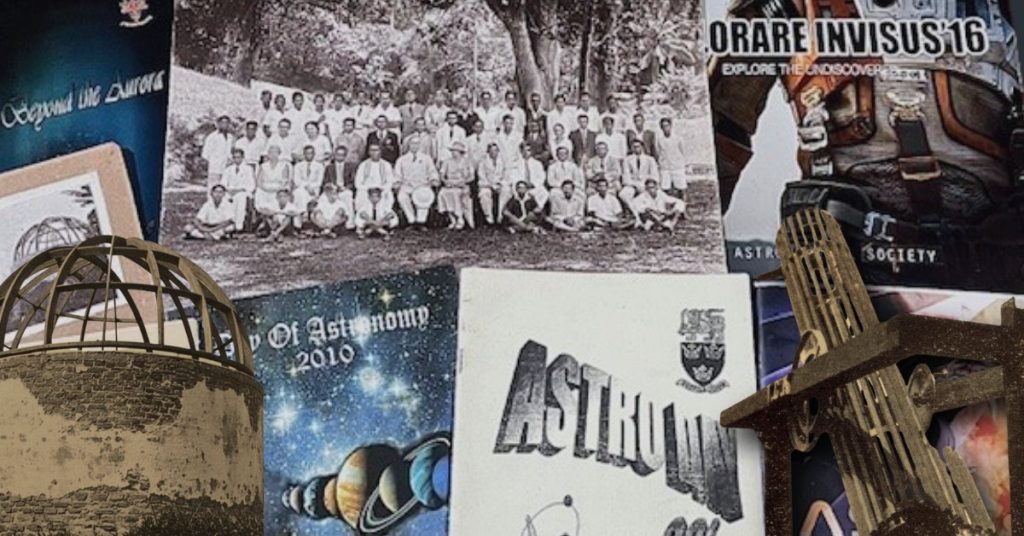
97 years ago, on 22 October 1928, a group of visionary students at Trinity College, Kandy, founded the Astronomical Society. What began as a shared curiosity for the stars soon evolved into one of the College’s most enduring and pioneering student-led societies.
The first Secretary of the Society was P. R. Perera, while the then Principal, Rev. McLeod Campbell, served as its President—underscoring the importance placed on scientific exploration even at that time. The Society’s primary aim was to encourage and facilitate the study of astronomy among students
Among those who contributed significantly to its founding was Mr D. A. Devendra B.A., who was later honoured with a fellowship from the Royal Astronomical Society, a rare distinction that reflects his influence and commitment.
While early meetings were centred on lecture papers, the Society soon aspired to greater heights—quite literally. Within a few years, they began work on an observatory. The construction of the observatory’s mirror was entrusted to Rev. W. F. G. Ellison, Director of the Armagh Observatory in Ireland. The foundation stone was ceremonially laid by Miss Mary Campbell on 19 June 1933.
Just eight months later, the telescope was completed and proudly exhibited in the same year. The observatory’s dome was constructed after the telescope had been installed. This observatory—described at the time as the largest in Ceylon—was officially declared open by Sir Graeme Tyrell, Chief Secretary of Ceylon and Acting Governor.
In 1952, the observatory suffered a major setback when a falling tree severely damaged the telescope. Despite multiple repair efforts, its peak period came to a premature end. Yet, the spirit of discovery continued. Students remained engaged, observing the skies and keeping alive the legacy of those who had once dared to build a window into the cosmos.
Today, as we mark 97 years since its founding, we remember the Astronomical Society with deep gratitude and pride. The passion of those early pioneers still echoes across the generations, inspiring Trinity students to look upwards and think beyond.
Article by: Trinity College Archives & Museum Team